
Designing Systems that Work for ALL Students
“When a flower doesn’t bloom, you fix the environment in which it grows, not the flower.”
— Alexander den Heijer
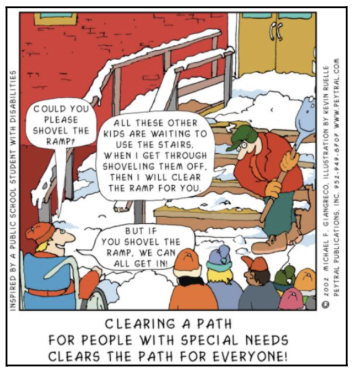
What is Universal Design for Learning (UDL)?
Universal Design for Learning (UDL) is a framework to improve and optimize teaching and learning for all people based on scientific insights into how humans learn.
The main goal for ALL students in a UDL classroom is to become Expert Learners. An Expert Learner is Resourceful and Knowledgeable, Strategic and Goal Directed, Purposeful and Motivated. The UDL framework is intended to be used in all tiers of instruction, beginning with strong core instruction for ALL students.
ED&D continues to believe that creating an inclusive and equitable classroom is achievable using the UDL Framework. The Engagement Principle considers offering multiple means in recruiting interests, sustaining effort and persistence, and self-regulation. These guidelines support social-emotional learning through relationship skills, social awareness, and responsible decision making.
Building Equity Begins with Design
CAST created the Universal Design for Learning (UDL) framework so that all learning experiences in school, the workplace, and life are thoughtfully designed to elevate strengths and eliminate barriers, because everyone deserves the opportunity to grow and thrive.
UDL is based on principles that empower everyone to have agency over their own learning. It allows educators and learners to set clear goals, anticipate environmental barriers, create meaningful options, and fully embrace human variability. CAST invites you to attend the UDL-Con: International Live Online conference. Register here!
Design with LUDIA: Bringing UDL to Life with AI
As part of the Statewide System of Support, Open Access is honored to spotlight LUDIA as a valuable resource for supporting UDL implementation. LUDIA is an AI-powered tool designed to help educators create inclusive and engaging learning environments. It provides personalized, context-specific strategies to minimize learning barriers and empower all learners to achieve their full potential. As AI continues to shape the future of education, tools such as LUDIA demonstrate how technology can be leveraged thoughtfully.
SDCOE Universal Design for Learning Design Jam
Registration is now open! Come together with other San Diego County Office of Education (SDCOE) professionals to leverage UDL as a powerful tool for advancing equitable practices and collectively removing barriers to learning for all.
During the UDL Design Jam on June 1 & 2, 2026, attendees will learn together with opening and closing sessions led by national expert and author, Andratesha Fritzgerald, and work collaboratively in teams throughout the day at a pace and order that makes sense for each team. The agenda is flexible, allowing space for conversations and learning with regional experts to guide, challenge, and support the work.
UDL Resources to Support ALL Students
There are several professional learning recordings available through YouTube, some of which can be accessed here. Additionally, various websites provide community resources such as CAST, UDL Center at OCALI, OCALI, and UDL-IRN, The California Collaborative for Educational Excellence (CCEE) has also developed a UDL Data Toolkit. Also, Open Access is a leader and significant resource for professional development in the area of universal design for learning.
Conclusion: There is no average brain
“UDL is based on principles that empower everyone to have agency over their own learning. It allows educators and learners to set clear goals, anticipate environmental barriers, create meaningful options, and fully embrace human variability. As UDL is studied and implemented around the world, the body of research revealing how UDL benefits learners of all ages and learning contexts continues to grow” (CAST).